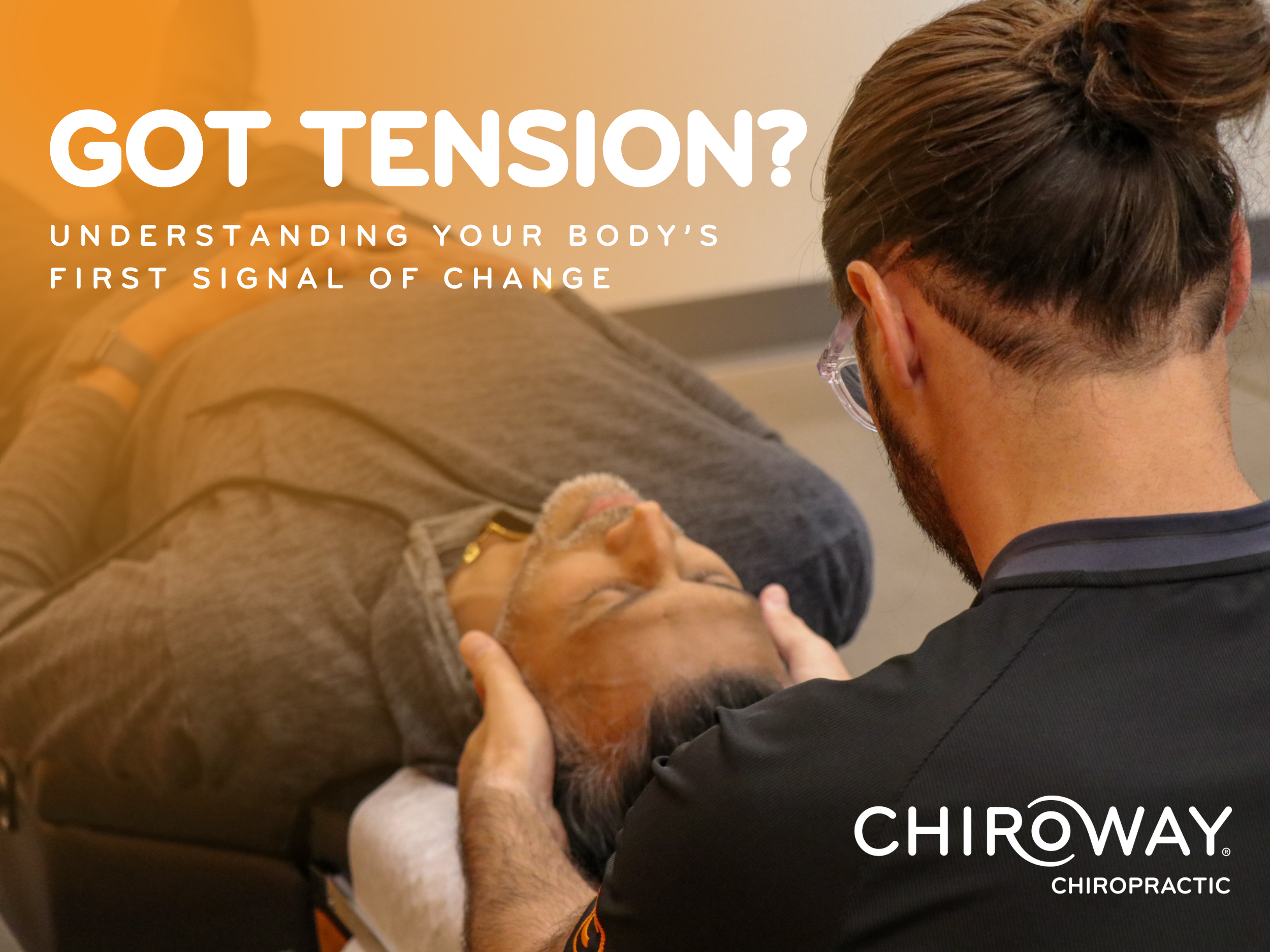
Got Tension? Understanding Your Body’s First Signal of Change
Why feeling tight is often the first sign your nervous system is under demand.
Every new year begins with the same hidden advantage: your body is already communicating with you, now we just need to listen. For most people, the first thing they notice is tension and tightness.
Tight shoulders.
A restricted neck.
A feeling of being “compressed” or wound up.
In chiropractic, we often refer to this experience as tension — the neurological and muscular expression of the body responding to demand. Different words. Same signal.
Very often, the first message of too much demand and not enough supply shows up as tightness and tension. Not a mistake. Not a defect. And definitely not “just stress.”
According to The 2027 Chiropractic Textbook, tension is an intelligent response — a visible expression of the body organizing itself to stay in existence. As articulated by Claude Lessard, this process is governed by the Universal Principle of Organization, which states that all matter, living and non-living, is continuously organized in order to persist.
In simple terms:
your tightness and tension are telling you something.
And it’s telling you if adaptation is occurring or accumulation of demand is fixated.
Why Tightness and Tension Matter More Than You Think
One of Claude Lessard’s core clarifications in The 2027 Chiropractic Textbook is that the body is never passive.
It is always:
-
Receiving information from the internal and external environment
-
Processing internal and external demands through the nervous system
-
Reorganizing structure and function in response to those demands
-
Coordinating countless adaptive cycles at once
Organization, as Lessard emphasizes, is constant and intelligent.
The body is always working to maintain coherence, efficiency, and stability.
This is why tightness and tension are not random.
When tightness increases, it indicates that the nervous system is working harder to maintain coherence under changing or increasing demand.
Lessard explains that organization precedes adaptation.
Before the body can change how it functions, it must first reorganize itself.
The earliest observable sign of that reorganization is often tightness, increased tone, or tension within the muscles, ligaments, fascia, and neurological pathways.
Think of tightness and tension as: potential energy + a protective strategy. Not a problem — but a precursor.
Tone: The Language of the Neurological System
In Volume 2 of The 2027 Chiropractic Textbook, Claude Lessard defines tone as the normal degree of neurological tension required for proper function.
Tone is not inherently good or bad.
It is informational.
It is the way the nervous system communicates demand, response, and readiness throughout the body.
Healthy tone allows the body to:
-
Move efficiently without unnecessary effort
-
Adapt smoothly to physical, chemical, and emotional stressors
-
Coordinate posture and breathing with minimal strain
-
Respond to stress and recover appropriately
When tone becomes excessive or insufficient, it reflects an imbalance in the transmission and expression of information within the neurological system. This imbalance is often experienced as tightness and tension in the body.
This may show up as:
-
Tight shoulders or upper back
-
Neck tightness or restricted movement
-
Shallow or restricted breathing
-
Jaw tension or teeth grinding
-
Low energy or fatigue
-
A general feeling of being “compressed” or restricted
Lessard connects these experiences to the Innate Laws of Living Things, explaining that the body is always adapting to its environment using built-in intelligence. Tightness and tension are not signs of failure — they are signs of active adaptation.
The key question is not whether tightness and tension exist, but:
Is this tension adaptive or accumulative?
Adaptive tension supports response and recovery.
Accumulative tension begins to interfere, creating abnormal or inefficient cycles over time.
When accumulation lingers, the body’s ability to coordinate and adapt can diminish. Over time, this often shows up as breakdown patterns — commonly experienced as neck pain and back pain.
Where Chiropractic Fits In: Addressing Tightness, Tension, and Neurological Interference
As Claude Lessard clarifies through the Chiropractic Objective, chiropractic does not address effects — it addresses interference with organization.
In other words, chiropractic is not about chasing symptoms.
It is about restoring clarity in how the body organizes, adapts, and expresses itself.
A Tonal Chiropractor locates where tightness and tension have stopped functioning as useful information and have become fixed, distorting normal neurological communication.
The chiropractic adjustment is designed to:
-
Restore clarity in neurological signaling
-
Reduce interference in information flow
-
Allow the body to reorganize itself more efficiently
When tightness reduces and tone normalizes:
-
Coordination improves
-
Adaptation requires less effort
-
Energy is conserved
-
Recovery accelerates
The body does not need to be forced.
It needs the opportunity to re-express its innate organization.
Each specific chiropractic adjustment supports clearer computation and coordination within the nervous system. When tightness and tension are addressed early, before they become accumulative, the benefits compound throughout the year:
-
Energy improves
-
Mental clarity increases
-
Recovery speeds up
-
Stress becomes more manageable
This is how quality of life expands — not by reacting to breakdown, but by responding to early signals of tightness, tension, and organizational change.
Noticing tightness or tension more often lately? Your body may be asking for support.
Come visit us—find a ChiroWay location near you.